Showing posts with label breast. Show all posts

Jul 3, 2018

Agar Janin Sehat dan Kuat, Jangan Lupa Mengonsumsi 8 Makanan Ini


Penulis: Rohmitriasih

Vemale.com - Menjaga kandungan merupakan poin penting dalam masa-masa kehamilan, dan hal ini sangat diperhatikan khususnya bagi para mom yang tengah hamil pada kali pertama. Pada awal kehamilan, kondisi tubuh baik secara fisik maupun psikis harus benar-benar dijaga demi mendapatkan janin yang kuat dalam kandungan.

Menjaga kandungan ini bukan hanya dari segi makanan dan kesehatan, tetapi juga dari banyak pertimbangan lainnya. Menjaga kandungan inilah yang nantinya mampu menuntun seorang ibu mendapatkan proses persalinan yang lancar. Ada banyak hal yang bisa dilakukan dalam menjaga kehamilan, salah satunya adalah mengonsumsi makanan yang bisa menguatkan janin dalam kandungan.

Dilansir dari laman boldsky.com, inilah beberapa makanan yang bermanfaat menguatkan janin.

1. Telur
Telur kaya dengan protein. Telur juga merupakan makanan yang baik demi menjaga kuatnya janin dalam kandungan. Satu butir telur mengandung 2 gr lemak jenuh dan sekitar 7 gr protein lengkap dengan nutrisi lainnya bagi kesehatan kandungan. 

2. Kacang kedelai
Kacang ini memiliki saponin, asam phytc dan isoflavon yang tinggi, rendah lemak, dan memiliki kandungan protein yang tinggi sehingga baik bagi perkembangan janin.

3. Kacang polong
Kacang-kacangan adalah makanan yang mengandung protein tinggi sehingga tidak heran jika kacang akan baik bagi kesehatan kehamilan. Nutrisi yang terkandung dalam kacang polong tak hanya baik buat kesehatan janin tetapi juga kesehatan ibu.

4. Tahu
Sebagai hasil olahan dari kacang kedelai, jangan ragu untuk mengkonsumsi tahu di masa kehamilan muda mengingat tahu tinggi akan protein dan nutrisinya sangat baik bagi kelangsungan janin dalam kandungan.

5. Yogurt
Kalsium pada yogurt lumayan tinggi begitu pula dengan protein di dalamnya, bagi kamu yang sedang mengandung, usahakan untuk mengonsumsi yogurt dalam porsi tepat setiap harinya. Jika tak suka konsumsi yogurt secara langsung, konsumsilah yogurt bersama salad sayur, salad buah atau makanan lainnya.

6. Ikan segar
Ikan tinggi akan kandungan protein, kandungan omega 3 yang baik bagi otak, serta mengandung vitamin penguat janin.

7. Udang
Hampir sama dengan ikan segar, udang memiliki protein yang tinggi, kalsium tinggi, dan nutrisi lain di mana baik bagi kelangsungan kesehatan janin.

8. Susu murni
Meskipun protein dalam susu murni tidak setinggi pada yogurt, kandungan amino essensial pada susu murni masih sangat bagus buat kesehatan janin.

Ladies, itulah beberapa makanan yang bermanfaat menguatkan janin dalam kandungan. So mom, usahakan mengonsumsi makanan di atas dalam porsi cukup setiap harinya. Semoga informasi ini bermanfaat.


https://www.vemale.com/kehamilan/116243-agar-janin-sehat-dan-kuat-jangan-lupa-mengonsumsi-8-makanan-ini.html?utm_source=Detail-Artikel&utm_medium=most-popular&utm_campaign=vem-annual-report&utm_content=most-popular-2

Bynaturael Product:
Liquid Castile Soap


Dapat dibeli di (scan QR code):


This document is provided for reference purposes only and not necessarily reflect the opinion of bynaturael’s team . Train your mind to test every thought and keep on searching the final truth that satisfies the conscience inside you. Please visit our blog: bynaturael.blogspot.com

Jun 29, 2018

7 Makanan Super Sehat Untuk Mencegah Risiko Kanker Payudara

Penulis: Rohmitriasih

Vemale.com - Kanker payudara merupakan salah satu kanker paling mematikan bagi kaum hawa. Yang lebih mengerikan lagi, kanker payudara bisa berisiko pada siapa saja dengan gejala yang tak mudah ditebak. Pola hidup dan makan yang buruk digadang-gadang sebagai penyebab umum dari risiko kanker payudara. Untuk itu, penting bagi kita kaum hawa untuk memperhatikan pola hidup dan makan yang lebih sehat.

Dilansir dari laman bolsky.com, ada beberapa makanan super sehat yang bermanfaat mencegah risiko kanker payudara. Tak hanya sehat, makanan ini juga memiliki rasa yang enak, mudah ditemukan di pasaran dan ada di segala musim. Apa saja?

1. Jamur
Kandungan nutrisi dan vitamin yang terkandung di dalam jamur dipercaya ahli bisa menurunkan risiko kanker. Jamur juga mengandung senyawa yang bisa menekan pertumbuhan sel kanker dalam tubuh.

2. Buah Delima
Siapa yang tak mengenal buah satu ini. Buah delima merupakan buah dengan rasa enak, menyegarkan dan kaya manfaat buat kesehatan. Salah satu manfaat hebat buah delima adalah mencegah risiko kanker payudara. Polifenol dan antioksidan yang terkandung di dalam buah delima bisa menekan pertumbuhan sel kanker dengan baik.

3. Sayuran Hijau
Sayuran hijau mengandung berbagai nutrisi dan vitamin yang meningkatkan sistem kekebalan tubuh. Sayuran hijau juga mengandung antioksidan yang ampuh mencegah risiko kanker khususnya kanker payudara.

4. Brokoli
Tak hanya memiliki rasa yang enak, brokoli juga memiliki segudang manfaat sehat. Senyawa aktif pada brokoli bisa membunuh berbagai sel kanker di tubuh. Antioksidan di dalamnya juga menekan pertumbuhan sel kanker maupun tumor.

5. Bawang Putih
Para ahli mengungkapkan jika bawang putih sangat efektif membuat tubuh jadi makin sehat, bugar dan terhindar dari berbagai masalah kesehatan. Tak hanya menstabilkan tekanan darah dalam tubuh, bawang putih juga menstabilkan sistem kekebalan tubuh hingga mencegah tumbuhnya sel kanker.

6. Ubi Jalar
Wanita yang mengonsumsi ubi jalar secara rutin setiap hari dengan porsi yang tepat, ini akan menurunkan risiko kanker payudara hingga 17 kali lipat. Konsumsi ubi jalar juga akan menyehatkan sistem pencernaan, mencegah risiko diabetes, kolesterol hingga jantung.

7. Teh Hijau
Sejak zaman dulu, teh hijau telah menjadi obat herbal untuk berbagai macam penyakit. Teh hijau juga dikonsumsi secara rutin setiap hari demi dapatkan sistem kekebalan tubuh lebih kuat, lebih terjaga dan sehat. Penelitian terbaru menemukan teh hijau juga ampuh mencegah risiko kanker payudara pada wanita.

Itulah beberapa makanan super sehat yang bisa mencegah risiko kanker payudara. Selain makanan di atas, makanan lain yang tak kalah super sehat dalam mencegah kanker payudara antara lain adalah cabai, kunyit, telur, beras merah, wortel, buah jeruk dan buah chery.

Semoga informasi ini bermanfaat dan kita semua bisa selalu menerapkan pola hidup sehat sehingga terhindar dari risiko berbagai penyakit khususnya penyakit kanker payudara.


https://www.vemale.com/kesehatan/110977-7-makanan-super-sehat-untuk-mencegah-risiko-kanker-payudara.html?utm_source=Detail-Artikel&utm_medium=baca-juga&utm_campaign=vem-annual-report&utm_content=artikel-crosslink

Bynaturael Product:
Liquid Castile Soap


Dapat dibeli di (scan QR code):


This document is provided for reference purposes only and not necessarily reflect the opinion of bynaturael’s team . Train your mind to test every thought and keep on searching the final truth that satisfies the conscience inside you. Please visit our blog: bynaturael.blogspot.com

May 21, 2014

A Cancer Treatment in Your Medicine Cabinet?


By MICHELLE HOLMES and WENDY CHEN |MAY 19, 2014

WE believe that it might be possible to treat breast cancer — the leading cause of female cancer death — with a drug that can already be found in nearly every medicine cabinet in the world: Aspirin.

In 2010, we published an observational study in The Journal of Clinical Oncology showing that women with breast cancer who took aspirin at least once a week for various reasons were 50 percent less likely to die of breast cancer. In 2012, British researchers, by combining results from clinical trials that looked at using aspirin to prevent heart disease, found that aspirin was also associated with a significantly lower risk of breast cancer death.

And yet, until now, there have been no randomized trials (the gold standard of research) of aspirin use among women with breast cancer.

It’s not hard to see why: Clinical trials are typically conducted on drugs developed by labs seeking huge profits. No one stands to make money off aspirin, which has been a generic drug since the Treaty of Versailles in 1919, and which costs less than $6 for a year’s supply.

Thankfully, the first randomized clinical trial is now going on in Britain, made possible by funding from a nonprofit group, Cancer Research UK. But the British study is looking at four cancers, and won’t be done until 2025. If we in the United States had funding to do a similar trial, we could combine our data and get answers much faster. If the United States is to maintain its role as the global leader in biomedical research, it must fund its own trial of aspirin in breast cancer.

Aspirin was originally derived from willow bark, which has been used as a painkiller since the time of Hippocrates. We don’t know exactly why it appears to work in fighting cancer. Aspirin reduces inflammation, and that may play a role in inhibiting the growth of tumors — perhaps by slowing the development of new blood vessels that nourish them, or by fighting old cells that keep growing when they should be dying off. It may also inhibit estrogen production, and we know that estrogen fuels the growth of most (but not all) breast cancers.

If we could prove that aspirin was an effective treatment in a clinical trial, it would have major implications, especially for low-income patients. Modern hormonal treatments, used after surgery to try to prevent cancer from recurring, last a standard five years and can cost between $1,200 and $2,300 a year. But not everyone who needs them is actually taking them. Higher co-pays reduce the number of women who fill their prescriptions, according to a 2011 study.

And that is just in the United States. Africa, Asia and Central and South America already account for more than 60 percent of the world’s cancer cases and about 70 percent of cancer deaths, according to the World Health Organization. The majority of the impact of the disease will be felt in those areas in the coming decades. Aspirin’s minimal cost would make it available in every country on earth, and for millions of women it could mean the difference between some treatment and none.

It may also offer an alternative treatment to women who cannot tolerate widely used cancer drugs because of debilitating side effects. For example, Columbia University researchers found that half of breast cancer patients taking hormonal treatments (specifically, tamoxifen and aromatase inhibitors) were unable to take the drugs for the recommended five years. A survey by the advocacy group Breast Cancer Action found that the predominant reason was joint pain. The most serious possible side effects of taking aspirin are gastrointestinal bleeding and stroke, but they are rare.

If aspirin truly works, we estimate that we could save 10,000 lives per year in the United States, and 75,000 in the developing world.

It won’t take much to find out. A randomized study of approximately 3,000 women with Stage 2 and 3 breast cancer, lasting five years, would cost around $10 million. (We wouldn’t study women with Stage 1 disease because they have such a high survival rate already, nor women with Stage 4 cancer, because there is not enough evidence that aspirin would help when the disease has advanced that far.)

Although $10 million is a relatively small amount for a large pharmaceutical company, it is too big for most federal grant mechanisms and nonprofit foundations. Our repeated attempts since 2010 to seek funding through federal grant mechanisms have been rejected.

Yet even as government funding for research is slashed, the government is still willing to test new cancer drugs pushed by pharmaceutical companies, despite very high failure rates for those drugs. Federal grant review panels have no direct financial interest in the studies they approve for funding, but inevitably they are seduced by the more novel treatments — the scientific equivalent of the latest smartphone. And generic drugs, particularly ones as old and familiar as aspirin, just aren’t sexy.

There’s a saying attributed to Hippocrates that extreme remedies are appropriate for extreme diseases. But in the case of breast cancer, the most simple of drugs may be the next great weapon.

Michelle Holmes and Wendy Chen are physicians and faculty members at Harvard Medical School.

Source: http://www.nytimes.com/2014/05/20/opinion/a-cancer-treatment-in-your-medicine-cabinet.html?contentCollection=opinion&action=click&module=NextInCollection&region=Footer&pgtype=article

Bynaturael Products:
Natural Hair Care
Liquid Castile Soap
This document is provided for reference purposes only and not necessarily reflect the opinion of bynaturael’s team . Train your mind to test every thought and keep on searching the final truth that satisfies the conscience inside you. Please visit our blog: bynaturael.blogspot.com

Mar 5, 2014

What are parabens and do I need to worry about them?


By Eleni N. GagePublished |February 26, 2014

Parabens have been widely used in products to prevent bacteria growth since the 1950s.

“About 85 percent of cosmetics have them,” said Arthur Rich, a cosmetic chemist in Chestnut Ridge, New York. “They’re inexpensive and effective.”

New York City dermatologist Dr. Fran E. Cook-Bolden explained, “Parabens have a long history of safe use, and that’s why they’re commonplace. New preservatives have less of a proven track record.”

In fact, typically, more than one form of the ingredient is used in a product. The most common are butylparaben, methylparaben, and propylparaben. Over the last few years, however, in response to customer concerns, many brands have started to manufacture (and label) paraben-free products, including lotions, lipsticks, shampoos, scrubs, and more.

So What’s the Problem?
In the 1990s, parabens were deemed xenoestrogens―agents that mimic estrogen in the body. “Estrogen disruption” has been linked to breast cancer and reproductive issues. And in 2004 British cancer researcher Philippa Darbre found parabens present in malignant breast tumors. As a result, experts in many countries are recommending limits on paraben levels in cosmetic products. What’s more, watchdog organizations worry that if parabens can be stored in the body, over time they could have a cumulative effect and pose a health risk.

But here’s the flip side: Critics of the British study point out that noncancerous tissue from healthy breasts wasn’t examined to see if parabens were also present there, and that the presence of parabens in tumors doesn’t prove that they caused the cancer. Other studies have shown parabens to have a very weak estrogenic effect.

All this leads to concern about the unknown. Cook-Bolden tells her patients that “so far there’s no scientific evidence to support any link with any form of cancer.” Currently, the amount of parabens in any product is typically quite small. The U.S. Food and Drug Administration and the World Health Organization consider the chemicals safe at low levels.

The Bottom Line?
There’s reason to be mindful, but no reason to have an all-consuming concern about these chemicals. If it helps you rest easy, use a paraben-free body lotion (which coats a large area of skin). Today there are a number of formulas available from paraben-free brands. Labels that list the preservatives as one of the last four ingredients also indicate that the chemicals are present in very small amounts, said Andrea Kane, editor of Theorganicbeautyexpert.com.

If you want to play it extremely safe, use a few oil-based organic products that don’t contain water (which calls for a preservative). They often come in dark containers with a pump so that light and air don’t degrade them quickly.

“With truly natural products, just stay within their use-by date,” Kane said. “It’s like milk―the date is there for a reason.”

http://www.foxnews.com/health/2014/02/26/what-are-parabens-and-do-need-to-worry-about-them/

Bynaturael Products:
Natural Hair Care
Liquid Castile Soap
This document is provided for reference purposes only and not necessarily reflect the opinion of bynaturael’s team . Train your mind to test every thought and keep on searching the final truth that satisfies the conscience inside you. Please visit our blog: bynaturael.blogspot.com

Dec 30, 2013

Surprises found in hunt for environmental links to breast cancer


Tuesday, November 12, 2013
By Kerry Sheridan, AFP

WASHINGTON -- A decade-long research effort to uncover the environmental causes of breast cancer by studying both lab animals and a group of healthy U.S. girls has turned up some surprises, scientists say.
At the center of the investigation are 1,200 school girls who do not have breast cancer, but who have already given scientists important new clues about the possible origins of the disease.

Some risk factors are well understood, including early puberty, later age of childbearing, late onset of menopause, estrogen replacement therapy, drinking alcohol and exposure to radiation.

Advances have also been made in identifying risky gene mutations, but these cases make up a small minority. “Most of breast cancer, particularly in younger women, does not come from family histories,” said Leslie Reinlib, a program director at the National Institute of Environmental Health Sciences. “We have still got 80 percent that has got to be environmental,” said Reinlib, who is part of the Breast Cancer and the Environment Research Program (BCERP) program that has received some US$70 million in funds from the U.S. government since 2003.

Some of its researchers track what is happening in the human population, while others study how carcinogens, pollutants and diet affect the development of the mammary glands and breast tumors in lab mice. The program's primary focus is on puberty because its early onset “is probably one of the best predictors of breast cancer in women,” Reinlib said.

Puberty is a time of rapid growth of the breast tissue. Research on survivors of the Hiroshima atomic bombings in Japan has shown that those exposed in puberty had a higher likelihood of developing breast cancer in adulthood. The 1,200 U.S. girls enrolled in the study at sites in New York City, northern California and the greater Cincinnati, Ohio, area beginning in 2004, when they were between the ages of six and eight.

The aim was to measure the girls' chemical exposures through blood and urine tests, and to learn how environmental exposures affected the onset of puberty and perhaps breast cancer risk later in life. Researchers quickly discovered that their effort to reach girls before puberty had not been entirely successful.

“By age eight, 40 percent were already in puberty,” said Reinlib. “That was a surprising bit of information.” Further research has shown that the girls appear to be entering puberty six to eight months earlier than their peers did in the 1990s.

Obesity an Influencing Factor

A study published last week in the journal Pediatrics on this cohort of girls found that obesity was acting as a primary driver of earlier breast development. Other studies on the girls have focused on chemicals that are known as endocrine disruptors because they are believed to cause either earlier or later breast development.

Initial results showed “for the first time that phthalates, BPA, pesticides are in all the girls they looked at,” said Reinlib. Researchers were taken aback by the pervasiveness of the exposures, but also by the data which appeared to show some plastic chemicals might not be as influential on breast development as some have feared.

“They didn't find much of an association between puberty and phthalates, which are these chemicals that leach out of plastic bottles and Tupperware,” Reinlib said. Another major finding regarded blood chemicals from two nearby groups in Ohio and Kentucky, both drinking water that was apparently contaminated by industrial waste.

Girls in northern Kentucky had blood levels of an industrial chemical — perfluorooctanoic acid (PFOA or C-8) found in Teflon non-stick coating for pans — three times as high as those who drank water from the Ohio River near Cincinnati, where water was filtered with state-of-the-art technology.

“Northern Kentucky did not have granular activated carbon filtration” in their water supply said researcher Susan Pinney, a professor at the University of Cincinnati School of Medicine. “In 2012 they put it in after they learned of our preliminary results.” Families were also notified of their daughters' blood levels, she said.

The chemicals can linger in the body for years. Researchers were dismayed to learn that the longer the girls spent breastfeeding as infants — typically touted for its health benefits — the higher their PFOA levels compared to girls who were fed formula.

What cannot be studied in the girls is tried on lab mice, who in one experiment are being fed high-fat diets and exposed to a potent carcinogen to see how the two interact. Mammary tumors develop much faster in the high-fat diet group, said scientist Richard Schwartz of the Department of Microbiology and Molecular Genetics at Michigan State University.

Fat mice have more blood supply in the mammary glands, higher inflammation levels and display changes in the immune system. Follow-up studies suggest that cancer risk stays high even if mice are fed high-fat diets in puberty and switched to low-fat diets in adulthood, he told AFP.

“The damage is already done,” he said. “Does this mean that humans are at risk the same way? We don't know that with certainty.” But the findings do reinforce the advice that people often hear regarding how to maintain good health — avoid fatty foods, maintain a normal weight and reduce chemical exposures wherever possible, experts say.

Breast cancer is the most common cancer in women globally and took 508,000 lives in 2011, according to the World Health Organization.

https://www.chinapost.com.tw/health/cancer/2013/11/12/393410/Surprises-found.htm

Bynaturael Products:
Natural Shampoo
Liquid Castile Soap
This document is provided for reference purposes only and not necessarily reflect the opinion of bynaturael’s team . Train your mind to test every thought and keep on searching the final truth that satisfies the conscience inside you. Please visit our blog: bynaturael.blogspot.com

Nov 28, 2013

Tips for fighting cancer with exercise


Reduce your waistline and breast-cancer risk
More than two dozen studies have shown that women who exercise have a 30 percent to 40 percent lower risk of breast cancer than their sedentary peers. The female hormone estrogen seems to play a key role. Women with high estrogen levels in their blood have increased risk for breast cancer. Since exercise lowers blood estrogen, it helps lower a woman’s breast-cancer risk. Exercise also reduces other cancer-growth factors such as insulin.

Even older women need to be concerned about estrogen, because after menopause the hormone is produced by fat cells. Women who exercise have less fat and therefore produce less estrogen. With more than 150,000 new breast-cancer cases reported in the United States each year, preventing cancer through exercise is one of the best ways a woman can take charge of her health.

Win the battle against colon cancer
Exercise plays a dramatic role in preventing cancer of the colon and rectum. Nearly 150,000 Americans are diagnosed with colorectal cancer each year, and nearly 50,000 die from the disease. Encouragingly, more than three dozen studies show exercisers reduce their risk of colon cancer by 20 percent or more compared to sedentary people, and the benefits are seen in both men and women, although the effect is greater in men. Changes in digestive acids and other substances also occur with exercise, and these changes are believed to provide some protection from colon cancer. Decreases in body fat, insulin and other growth factors also may contribute to exercisers’ lower colon-cancer risk. Current research is also uncovering new ways in which physical activity cuts cancer risk—from reducing chronic inflammation to improving DNA repair.

How much exercise is too much?
According to national activity guidelines, a good goal is to exercise at least 30 minutes a day on most days of the week. To get the most benefit, though, aim for about an hour a day. Moderate-intensity activities such as brisk walking may be sufficient, although there is more benefit with increased intensity.

Get up off the couch!
It’s easier than you think! A half hour of physical activity daily such as walking, slow swimming, leisurely bike riding or golfing without a cart will get you started. Here are some other ways to be more active:

·         Use stairs rather than an elevator.
·         Walk or bike to your destination, and walk around the block after dinner.
·         Exercise at lunch with your family or friends.
·         Go dancing.
·         Wear a pedometer every day and watch your daily steps increase.
·         Join a sports team.
·         Walk to visit co-workers rather than send an e-mail.
·         Use a stationary bike or do sit-ups, leg lifts and push-ups while watching TV.
·         Park a little farther from your office, the store or the library for a nice walk.
·         When the weather is too poor to be outside, grab a partner and “walk the mall.”
·         Vary your type of exercise so you won’t get bored or think it’s a chore.

Often people view exercise narrowly as a way to lose weight or to look better. These incentives can be effective, but exercise is really about a person taking charge of his or her health, preventing chronic diseases like cancer, and living longer.

Women it's never too late to start

Even moderate activity can be critically important in helping menopausal women reduce their risk of cancer, heart disease and other chronic ailments. Exercise reduces fat deep in the abdomen (“intra-abdominal” fat), a hidden risk factor because it can raise insulin levels, which promote the growth of cancer cells as well as cholesterol levels. Most American women gain 1 to 2 pounds on average every year, and that adds up to dangerous levels over a lifetime.

The beauty of exercise as a method to reduce total and intra-abdominal fat—and therefore chronic disease —is that it can be done by most women at low cost and with low risk of side effects. It’s never too late to enjoy the health benefits of exercise!

Want more information?

For more information on this and other cancer-related topics, call the National Cancer Institute’s
Cancer Information Service at 1-800-4-CANCER (1-800-422-6237) or visit www.cancer.gov.

Source: http://www.fhcrc.org/en/events/healthy-living/Trim-Risk.html

Bynaturael Products:
Natural Shampoo
Liquid Castile Soap
This document is provided for reference purposes only and not necessarily reflect the opinion of bynaturael’s team . Train your mind to test every thought and keep on searching the final truth that satisfies the conscience inside you. Please visit our blog: bynaturael.blogspot.com

Sep 30, 2013

Breast Health, a Great Reason to Love Peanut Butter and Jelly


By Sarah B. Weir, Shine Senior Writer | Healthy Living

Peanut butter is a delicious snack, but here's another incentive to dig into a jar of crunchy. New research indicates that older girls who regularly eat peanut butter, nuts, and other sources of vegetable protein and fat may reduce their risk of developing benign breast disease (BBD) by as much as 39 percent. The findings are based on data collected from over 9,000 girls and young women who participated in Growing Up Today, a long-term research study led by Harvard Medical School and Brigham and Women's Hospital. While BBD, which includes a range of conditions, such as cysts and benign tumors, is noncancerous, some forms of it can increase the risk of developing breast cancer later in life.

The findings were based on the reported dietary habits of girls aged 9 to 15 between the years of 1996 to 2001. Later, from 2005 to 2010, the same participants reported whether they had been diagnosed with benign breast disease that had been confirmed by a biopsy. Researchers found that girls who ate two regular servings of peanut butter or nuts per week were 39 percent less likely to be diagnosed with BBD by age 30. "These findings suggest that peanut butter could help reduce the risk of breast cancer in women," senior author Graham Colditz of the Washington University School of Medicine, and senior author of the study, tells Yahoo Shine.

For maximum protection, Colditz recommends that girls add two one ounce servings of peanuts or peanut butter to their diets on top of what they are already consuming each week. He says that for girls with nut allergies, “We looked at beans,lentils, and soybeans—other vegetable proteins—and we saw benefits there as well. It’s a pretty clear message that for many out there with allergies, you can eat other sources of vegetable proteins.”

In recent years, there has been a great deal of compelling evidence linking lifestyle habits to the prevention of breast cancer. A previous study, also conducted by Colditz, found that drinking alcohol during adolescence can increase a girl's risk of breast cancer by 11 percent.

Other research suggests that:
·         Regular exercise lowers women's breast cancer risk.
·         Cutting out saturated fats can reduce risk.
·         Avoiding smoking, especially for premenopausal women, may reduce risk.
·         A plant-based diet rich in whole grains, lean protein, and fruits and vegetables increases the chance of surviving breast cancer.
·         Breastfeeding is linked to a lower risk of cancer.               
·         Avoiding refined sugar may help prevent early-stage breast cancer from metastasizing.


The peanut study also reported that girls who ate a daily serving of beans, lentils, soybeans, or corn had a reduced risk of BBD, but the link was weaker because they consumed less in general. The researchers also looked at the consumption of dairy products and concluded it had no impact on risk.
While previous studies have also found a link between eating these foods and a lower risk of BBD, this is the first to use evidence reported while the participants were still adolescents. Because nuts are high in calories, Colditz suggests that girls eliminate any junk food snacks and sugary drinks that are already included in their diet in favor of eating nuts.

http://shine.yahoo.com/healthy-living/breast-health-great-reason-love-peanut-butter-jelly-154500319.html

Bynaturael Products:
Natural Shampoo
 Liquid Castile Soap
This document is provided for reference purposes only and not necessarily reflect the opinion of bynaturael’s team . Train your mind to test every thought and keep on searching the final truth that satisfies the conscience inside you. Please visit our blog: bynaturael.blogspot.com

Sep 3, 2013

10 Ways to Help Prevent Breast Cancer


June 14, 2013 | By Irma Wallace
Breast cancer is still a very real threat to human nowadays no matter how hard people have been trying to fight against it. Everyday, breast cancer affects life of thousands of women throughout the world.

The following infographic by PromoCode4Share.com provides a list that may help keep you from developing breast cancer. It is not a guarantee that you won’t get breast cancer. But by following these strategies you may lower your odds in getting breast cancer and you may also improve your overall health.


10 Ways to Help Prevent Breast Cancer


Bynaturael Products:
Natural Shampoo
Liquid Castile Soap
This document is provided for reference purposes only and not necessarily reflect the opinion of bynaturael’s team . Train your mind to test every thought and keep on searching the final truth that satisfies the conscience inside you. Please visit our blog: bynaturael.blogspot.com


Aug 6, 2013

Bahan Kimia di Kosmetik Penyebab Kanker Payudara


Wanita dan kosmetik telah 'bersahabat' sejak lama. Tapi nampaknya, Anda harus berhati-hati karena 'sahabat' setia Anda itu bisa saja mencelakakan Anda. Pasalnya, banyak produk kosmetik menggunakan zat kimia yang dapat meningkatkan risiko kanker payudara.

Seperti dilansir dari Daily Mail, beberapa studi sejak tahun 1998 menemukan peran potensial zat paraben terhadap kanker payudara karena zat kimia tersebut memiliki sifat estrogenik, menyerupai estrogen. Hormon estrogen diketahui memiliki peran penting dalam pertumbuhan, pengembangan, dan perkembangan payudara.

Paraben atau asam para-hidroksibezoat banyak digunakan dalam kosmetik untuk membuat kosmetik tahan lama karena mereka mampu melawan pertumbuhan mikroba pada kosmetik. Biasanya paraben ditemukan pada produk mandi sehari-hari seperti pelembab, kosmetik, shaving foam, tanning lotion, dan pasta gigi.

Zat kimia ini juga ditemukan dalam deodoran. Juga, makanan olahan seperti sosis, dan kue kering yang gurih.

Paraben yang paling umum ditemui dalam produk kosmetik adalah methylparaben, propylparaben, dan butylparaben. Sedangkan, yang tidak umum ditemukan adalah benzylparaben dan sobutylparaben. Zat-zat ini dapat dilihat pada kemasan produk.

Tim peneliti yang dipimpin oleh Dr Philippa Darbre dari Universitas Reading memelajari sampel jaringan dari 40 wanita Inggris yang menjalani masektomi antara 2005 hingga 2008 karena telah menderita kanker payudara.

Dikumpulkan 160 sampel, empat sampel dari setiap responden. Tim peneliti pun menemukan 99 persen dari sampel jaringan terkandung setidaknya satu jenis paraben, dan 60 persen sampel mengandung lima jenis paraben.

Tim peneliti menemukan wanita yang tidak menggunakan deodoran, masih memiliki paraben dalam jaringan mereka. Asumsinya, paraben masuk dari sumber lain.

"Penelitian kami lakukan untuk mengonfirmasi pandangan bahwa tidak ada penyebab sederhana dan hubungan antara paraben dalam produk deodoran dengan kanker payudara," ujar rekan penulis Mr Lester Barr dari University Hospital of South Manchester.

Namun, yang menarik adalah penelitian ini menemukan adanya paraben pada wanita penderita kanker payudara yang tidak pernah menggunakan produk untuk ketiak. "Pertanyaannya, dari mana zat kimia tersebut masuk?"

Meski demikian, fakta adanya paraben pada jaringan payudara belum dapat dipastikan sebagai penyebab kanker payudara. "Namun, hal ini bisa menjadi dasar penelitian yang lebih lanjut," ujar Dr Darbre.

Menanggapi penelitian tersebut, Catherine Priestley, pakar perawatan kanker payudara mengatakan, "Debat mengenai hubungan paraben dengan kanker payudara bukan sesuatu yang baru. Tapi penelitian ini semakin mendukung dibutuhkannya penelitian lebih lanjut."

Adanya zat paraben dalam jaringan payudara yang terserang kanker memang belum terbukti akibat pemakaian produk kecantikan. "Tapi yang pasti, kanker payudara bisa muncul akibat peningkatan usia, jenis kelamin, dan sejarah kanker payudara dalam keluarga," ujarnya.

Sumber: http://kumpulandata.com/artikel/dataku/65746-bahan-kimia-di-kosmetik-penyebab-kanker.html


Bynaturael Products:
Natural Shampoo
Liquid Castile Soap
This document is provided for reference purposes only and not necessarily reflect the opinion of bynaturael’s team . Train your mind to test every thought and keep on searching the final truth that satisfies the conscience inside you. Please visit our blog: bynaturael.blogspot.com

Jun 18, 2013

The Good News About Cancer

Source: http://visual.ly/good-news-about-cancer

Bynatureal Products:
Natural Shampoo
Liquid Castile Olive Soap

This document is provided for reference purposes only and not necessarily reflect the opinion of bynaturael’s team . Train your mind to test every thought and keep on searching the final truth that satisfies the conscience inside you. Please visit our blog: bynaturael.blogspot.com

May 30, 2013

New Laws Add a Divisive Component to Breast Screening


October 24, 2012


In a move that has irked medical groups and delighted patient advocates, states have begun passing laws requiring clinics that perform mammograms to tell patients whether they have something that many women have never even heard of: dense breast tissue.

Women who have dense tissue must, under those laws, also be told that it can hide tumors on a mammogram, that it may increase the risk of breast cancer and that they should ask their doctors if they need additional screening tests, like ultrasound or M.R.I. scans.

The issue is pitting angry patients against the medical establishment. Advocates say women have a right to know, but medical groups argue that the significance of tissue density is uncertain and that reporting it may panic women and lead to an avalanche of needless screening tests and biopsies.

Laws requiring disclosure have been passed in Connecticut, Texas and Virginia, and most recently in California and New York, where they will take effect next year. A bill calling for a federal law has been introduced in the House.

The laws owe their existence mostly to Nancy M. Cappello, 59, of Woodbury, Conn. She was not told that she had dense breast tissue until after doctors found an advancedcancer that mammograms had missed. She took her story to legislators, and in 2009, Connecticut became the first state to require that women be told if they have dense breasts and that insurance companies cover ultrasound scans for those women.

“I want to help other women,” said Ms. Cappello, formerly the state’s chief of special education. “I can’t help myself. My cancer should have been detected at a much earlier stage.”
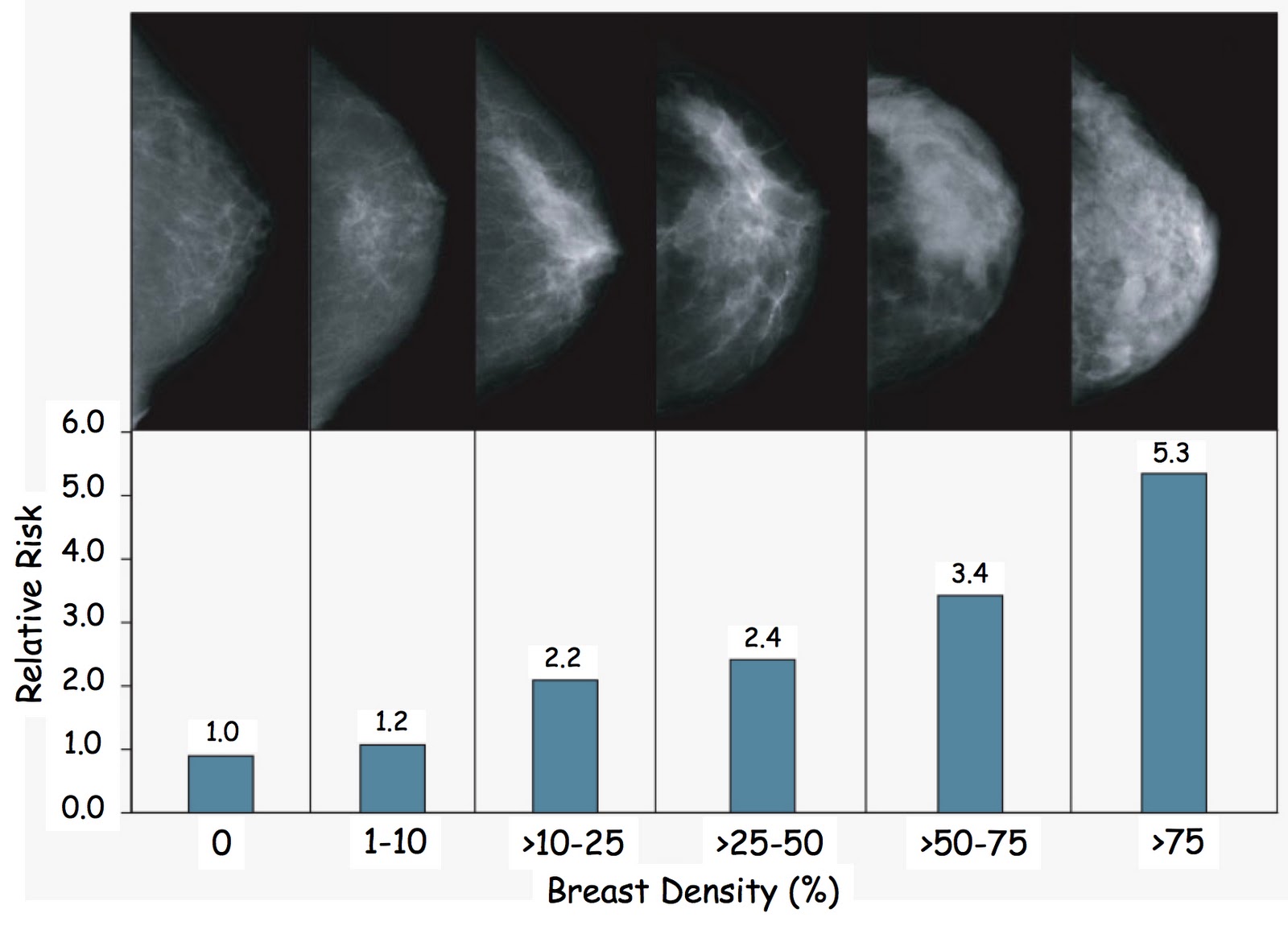
“Dense” breasts have a relatively high proportion of glandular or connective tissue, which blocks X-rays. Non-dense breasts have more fat, which X-rays penetrate easily. Over all, about 40 percent of women who have mammograms have dense breast tissue. It is not abnormal, just one of nature’s variations. Younger women are more likely to have dense tissue, but as many as 25 percent of older women do, too. Density cannot be judged by touch; it shows up only on mammograms.

For many women, the legislation will bring about a big change. Though some radiologists already tell women about density, in most cases the letters sent to patients about mammogram results do not mention it.

Though some doctors favor the laws, others resent them, and professional societies of radiologists, gynecologists and cancer experts have raised medical concerns.
The medical groups say telling a woman she has dense breasts may not help her and might even do harm by propelling her into unnecessary tests and treatment. The groups argue that identifying dense breast tissue is subjective, and so two doctors reading the same mammogram may rate the tissue differently. And information about density may confuse women, scare some needlessly and give others a false sense of security, the groups say.

Detractors also warn of a flood of phone calls to already-overburdened doctors and a demand for additional tests that will strain the health care system. There is already a shortage of experts in ultrasound screening, and many doctors simply bristle at the idea of laws controlling what they tell patients.

“I’m always worried when politicians start legislating the medical conversation, especially when it’s a medical conversation where the experts don’t know what needs to be said,” said Dr. Otis Brawley, the chief medical officer and executive vice president of the American Cancer Society and a professor of medicine at Emory University in Atlanta.

But Dr. Brawley said doctors should tell women if they have dense breasts, and he freely admitted that his position seemed contradictory.
“I’m saying I object to legislation that says doctors should have a conversation with their patients that I believe they should have with their patients,” he said.

The National Cancer Institute calls dense breasts “a strong risk factor for developing breast cancer.” Various studies have estimated that compared with other women, those with dense breasts are two to six times as likely to develop breast cancer. The reason is not known. But dense breasts have more milk ducts and lobes, where most cancers form, so some researchers think the added risk may come from having more of that tissue.

On mammograms, dense breasts look white, and so does cancer, so the tissue can hide tumors. Fatty breasts show up mostly black, so tumors stand out.
Studies have found that when women with dense breasts were given mammograms and then ultrasounds, the ultrasound found tumors that the mammograms missed — but also produced many false positives that led to biopsies.

Studies of women with dense breasts that were published in June in the journal Radiology and in April in The Journal of the American Medical Association found that for every 1,000 women screened, adding ultrasound found three to five cancers that mammograms missed. But in one study, 63 biopsies or other invasive procedures were performed to find three tumors.

M.R.I. exams can also find tumors that mammograms miss, but they produce even more false positives.
Despite its shortcomings, mammography does find some tumors in women with dense breasts — including some that ultrasound misses — so doctors emphasize that these women should not skip mammograms.

No studies have been conducted to determine whether finding the hidden cancers with ultrasound or M.R.I. scans saves women’s lives. In theory, the tumors found could be the kind that never would have killed the patients anyway. The United States Preventive Services Task Force, which makes recommendations about screening tests, has not given any advice on breast ultrasound.
This year, 226,870 new cases of breast cancer and 39,510 deaths from the disease are expected in the United States.

Dr. Thomas Kolb, a radiologist in Manhattan, said that like mammography, ultrasound can find early cancers and therefore should reduce the death rate.
“It doubles the detection rate in women with dense breasts,” he said.
But Dr. Carol H. Lee, a radiologist at Memorial Sloan-Kettering Cancer Center in New York and a spokeswoman for the American College of Radiology, said that while there is an increased overall cancer risk for women with dense breasts as a group, it is not known whether the risk is borne equally by every woman in the group. So the best advice for an individual woman is not clear.

Dr. Lee said that the radiology group did not oppose the idea of informing women but did not think it should be mandated by law. The group issued a statement warning of “possible harms and unintended consequences” of the state laws, including confusion, “undue anxiety,” a loss of faith in mammograms and “demands for additional non-mammographic screening.”

Some insurers may not cover the additional tests, so women who cannot pay out of pocket may not be able to afford them. Even when insurance does pay, the reimbursement rate is often so low that many doctors say it does not come close to covering the time and expertise needed to perform and interpret the exams. In addition, while mammography centers must meet strict standards, there are no such requirements for ultrasound screening, so the quality may vary.

Ms. Cappello, the woman who started the movement to inform patients, began having yearly mammograms at age 40. In 2004, when she was 51, her doctor felt a lump in her breast — only six weeks after a mammogram had looked normal. Even after the lump was detected, mammography still could not find it. Only then was Ms. Cappello told that she had dense breast tissue. The cancer had already spread to 13 lymph nodes. She needed a mastectomychemotherapy, radiation and hormone treatment.

Ms. Cappello was outraged. If she had known she had dense breast tissue, she said, she would almost certainly have had an ultrasound exam. She believes that the tumor would have been found earlier, perhaps even before it had begun to spread.
“It was probably growing for four or five years,” she said, “and it was missed.”

Source: http://www.nytimes.com/2012/10/25/health/laws-tell-mammogram-clinics-to-address-breast-density.html?pagewanted=all&_r=0

Related articles:

Breast facts in an
interesting video
The Cancer Lobby


This document is provided for reference purposes only and not necessarily reflect the opinion of bynaturael’s team . Train your mind to test every thought and keep on searching the final truth that satisfies the conscience inside you.
Please visit our blog: bynaturael.blogspot.com